An Urgent Message from Dr. Shashidhar B. K., Consultant Spine Surgeon, Bangalore Spine Specialist Clinic
You know that smoking and nicotine use—whether from cigarettes, cigars, or vaping—devastates your lungs and heart. But what if we told you that every puff also directly attacks the very foundation of your body: your spine?
Chronic back pain and spinal disorders are on the rise, and for a surprising number of people, the culprit is right in their hand. The effects of nicotine on spine health are profound, accelerating degeneration, hindering healing, and drastically reducing the success rate of spinal treatments and surgeries.
As a leading expert in complex and minimally invasive spine surgery in the city, Dr. Shashidhar B. K., Consultant Spine Surgeon at the Bangalore Spine Specialist Clinic, sees the undeniable damage firsthand. With extensive fellowship training from premier global institutions and a deep commitment to patient education, Dr. Shashidhar believes understanding this link is the first, crucial step toward a pain-free life.
🔬 The Anatomy of Damage: Why Nicotine Targets the Spine
To understand the danger, we must first look at the intervertebral discs—the spongy, shock-absorbing cushions between your spinal bones (vertebrae). These discs are crucial for flexibility and protecting your nerves.
Unlike most tissues in the body, which have a direct and robust blood supply, the inner part of your discs relies on a delicate process called diffusion to get its essential nutrients and oxygen from surrounding blood vessels.
1. The Nicotine-Induced Starvation of Your Discs
Nicotine is a powerful vasoconstrictor, meaning it causes blood vessels to narrow. This is the core mechanism of damage:
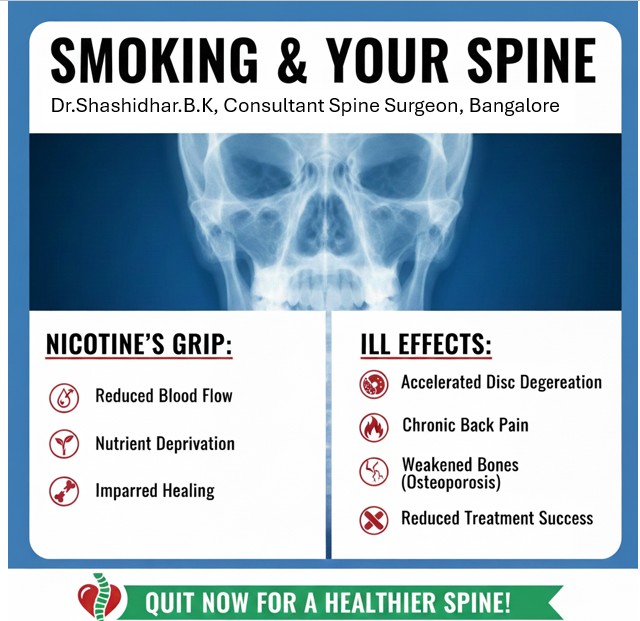
- Reduced Blood Flow (Ischemia): When vessels narrow, less blood can flow to the spine. This severely limits the oxygen and nutrients (like glucose) that can diffuse into your intervertebral discs.
- Carbon Monoxide Factor: In traditional cigarette smoke, carbon monoxide binds to your red blood cells, essentially hijacking the space where oxygen should be, further starving the spinal tissues.
This lack of essential sustenance leads to what is often called “disc malnutrition.” Over time, the discs dry out, lose their elasticity and height, and become brittle. This is the accelerated onset of degenerative disc disease.
2. Accelerated Degenerative Disc Disease
Nicotine doesn’t just cut off the supply line; it actively makes the disc cells weaker.
- Toxic Effect on Disc Cells: Nicotine has been shown to be directly toxic to the cells that maintain the disc’s structure. It slows down the production of key components like collagen and glycosaminoglycans (GAGs), which are responsible for keeping the disc hydrated and strong.
- Structural Breakdown: As the discs weaken, tiny tears (annular tears) can form in the tough outer ring (annulus fibrosus). These tears heal with weak scar tissue, making the disc wall progressively weaker and far more prone to herniation (often called a “slipped disc”).
- Earlier Onset: Studies consistently show that smokers are significantly more likely to develop degenerative disc disease and chronic back pain at a much younger age compared to non-smokers.
🔥 The Vicious Cycle of Nicotine and Inflammation
Beyond the physical structure, nicotine also throws your body into a state of chronic, low-grade inflammation.
Nicotine increases systemic inflammatory markers throughout the body, including in the spine. This constant state of inflammation not only makes existing pain worse but also breaks down spinal tissues faster, fueling a vicious cycle of pain and degeneration. This is why patients who smoke often report pain that is more severe and persistent, even for similar spinal conditions.
🦴 The Danger to Bone Health: Osteoporosis and Fractures
The spine is composed of 33 vertebrae, and the strength of these bones is paramount. Nicotine is a known risk factor for osteoporosis, a condition characterized by low bone mass and bone tissue deterioration.
- Impaired Calcium Absorption: Smoking interferes with your body’s ability to absorb calcium and may alter hormone levels essential for bone formation.
- Increased Fracture Risk: When the vertebrae become porous and brittle due to osteoporosis, they are highly susceptible to compression fractures, which can be extremely painful and debilitating, leading to spinal deformity (kyphosis).
⚕️ Nicotine and Spinal Surgery: A Matter of Success
Perhaps the most critical risk of smoking is its detrimental impact on surgical outcomes. For patients considering or scheduled for a procedure like a spinal fusion, quitting nicotine is not just a recommendation—it is often a mandatory requirement for success.
The Failure to Fuse (Pseudarthrosis)
Spinal fusion is a procedure where two or more vertebrae are permanently joined together to eliminate painful movement. It requires the body to grow new, solid bone across the joint space. Nicotine drastically hinders this vital healing process:
- Impaired Bone-Forming Cells: Nicotine is toxic to osteoblasts (the cells that build new bone).
- Poor Blood Supply: Reduced blood flow means the surgical site does not receive the necessary oxygen and growth factors to form a solid bridge of new bone.
Research shows that smokers have a significantly lower spinal fusion success rate, with some studies indicating they are two to four times more likely to experience a non-union (a failed fusion, or pseudarthrosis) compared to non-smokers.
Increased Complications
Nicotine also increases the risk of other major complications:
- Wound Healing: Reduced oxygen and blood flow lead to slower, poorer wound healing.
- Infection: This decreased healing, combined with an impaired immune response, increases the risk of post-operative surgical site infection.
- Increased Pain and Re-operation: Patients who smoke often experience more post-operative pain and are more likely to require costly and complex revision (re-do) surgery due to fusion failure.
🛑 Take Control: Your Path to a Healthier Spine
The evidence is clear: to protect your spine, improve your quality of life, and maximize your chances of a successful surgical outcome, you must eliminate nicotine use.
The good news is that the moment you quit, your body begins to heal. Quitting allows your blood vessels to dilate, improving circulation and beginning the slow process of re-nourishing your spinal discs and bone cells.
“I cannot stress enough the importance of smoking cessation for anyone experiencing back pain or contemplating spine treatment. Nicotine is a direct adversary to a healthy spine and a successful recovery. It is a modifiable risk factor, and taking control of it is the most powerful step you can take for your spinal health.”
— Dr. Shashidhar B. K., Consultant Spine Surgeon, Bangalore Spine Specialist Clinic
If you are struggling with chronic back pain, disc-related issues, or are considering spine surgery, the first step is a comprehensive consultation with an expert. Dr. Shashidhar B. K. specializes in a holistic, evidence-based approach to spinal care, ensuring every factor—including lifestyle habits like nicotine use—is addressed for optimal results.
Don’t let nicotine determine your future. Take the first step toward a stronger, pain-free spine.
📞 Consult Dr. Shashidhar B. K. in Bangalore Today
If you are seeking specialized care for degenerative disc disease, herniated disc, spinal stenosis, or need an expert opinion on your best treatment path—especially with a history of nicotine use—contact the Bangalore Spine Specialist Clinic.
Dr. Shashidhar B. K. and his team are dedicated to providing advanced spine solutions, from non-operative care to cutting-edge robotic and minimally invasive surgery, always prioritizing the best possible outcome for your long-term spine health.