By Dr. Shashidhar B.K., Consultant Spine Surgeon
Bangalore Spine Specialist Clinic
Persistent lower back pain that radiates down your legs can completely derail your everyday life. When conservative treatments like physical therapy, medication, and epidural injections no longer provide relief, surgical evaluation becomes the logical next step. For conditions such as spondylolisthesis, severe lumbar disc degeneration, or spinal instability, Transforaminal Lumbar Interbody Fusion (TLIF) is one of the most effective surgical solutions available.
However, once a surgeon mentions TLIF, patients are often presented with a key choice: Open TLIF or MIS TLIF (Minimally Invasive Surgery Transforaminal Lumbar Interbody Fusion).
While both procedures aim to accomplish the exact same clinical outcome—stabilizing the spine and relieving nerve pressure—the pathway to getting there differs significantly. This comprehensive guide breaks down the differences, benefits, recovery timelines, expectations, and frequently asked questions for both approaches in plain, easy-to-understand language.
What is TLIF?
Before comparing the techniques, it helps to understand what a TLIF actually accomplishes.
Transforaminal Lumbar Interbody Fusion (TLIF) is a technique used to join (fuse) two or more vertebrae in the lower back. During a TLIF:
- Decompression: The surgeon removes damaged disc tissue, bone spurs, or thickened ligaments that are pinching the spinal nerves (relieving leg pain and numbness).
- Interbody Placement: A specialized spacer or cage packed with bone graft material is inserted into the empty disc space between the vertebrae. This restores height and provides stability.
- Fixation: Screws and rods (pedicle screws) are attached to the vertebrae above and below the fused segment to hold the spine completely steady while the bone heals together over time.
Traditional Open TLIF: The Time-Tested Approach
Traditional Open TLIF has been the gold standard for lumbar spinal fusion for several decades.
How Open TLIF Works
In an open procedure, the surgeon makes a single long incision down the middle of your lower back. To clearly view the spinal anatomy, the large back muscles (erector spinae) are peeled back and separated away from the spine bones.
When Open TLIF is Preferred
While newer techniques have advanced rapidly, traditional open surgery remains valuable for:
- Complex multi-level spinal deformities.
- Severe revision surgeries where extensive scar tissue from past operations needs careful clearance.
- Cases requiring large-scale anatomical reconstruction.
Key Considerations of Open TLIF
Because the back muscles are detached and retracted for an extended period, open surgery typically leads to:
- Greater surgical blood loss.
- Increased immediate post-operative back soreness due to muscle disruption.
- Longer hospital stays and extended recovery periods.
MIS TLIF: The Modern, Muscle-Sparing Alternative
Minimally Invasive Surgery TLIF (MIS TLIF) was developed to accomplish everything an open fusion achieves, but without the extensive muscle disruption.
How MIS TLIF Works
Instead of one continuous mid-line incision and peeling back the muscles, MIS TLIF utilizes specialized tube-like instruments (tubular retractors) inserted through smaller incisions on either side of the back.
Rather than cutting or detaching the back muscles, the surgeon gently dilates (spreads) the natural muscular pathways apart layer by layer. Guided by real-time X-ray imaging (fluoroscopy) and high-magnification surgical microscopes or endoscopes, the surgeon performs the nerve decompression, places the interbody cage, and secures the pedicle screws precisely through these narrow tubes.
Advantages of MIS TLIF Over Open TLIF
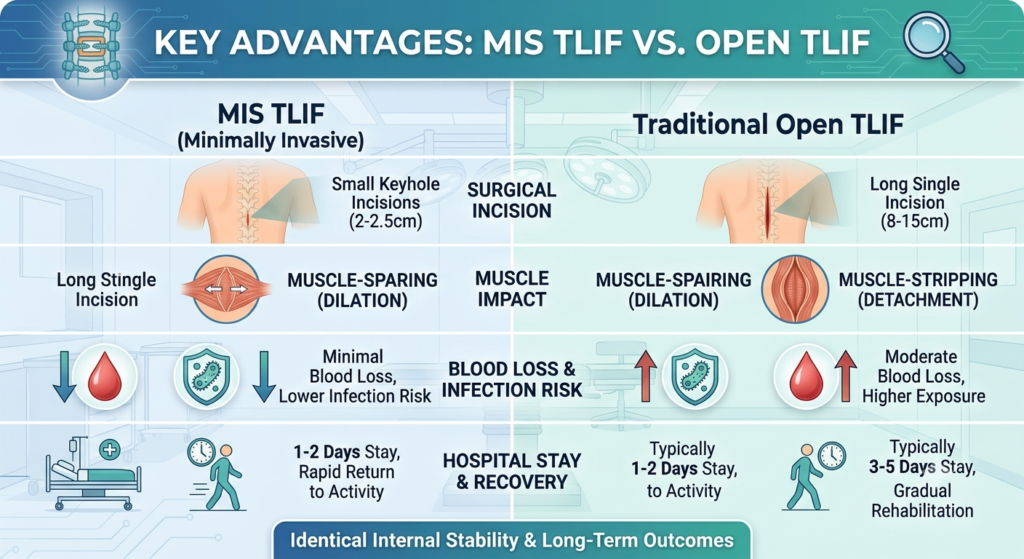
The key advantage of MIS TLIF lies in how it preserves natural anatomy. Because the structural back muscles and supporting ligaments remain intact, post-operative pain and recovery demands are substantially reduced.
| Clinical Feature | MIS TLIF | Traditional Open TLIF |
| Surgical Incisions | 2 to 4 small keyhole incisions (approx. 2–2.5 cm each) | 1 long central incision (approx. 8–15 cm) |
| Muscle Impact | Muscle-sparing (gentle dilation between muscle fibers) | Muscle-stripping (muscles detached and pulled back) |
| Blood Loss | Minimal (typically under 50–100 ml) | Moderate to High (often requiring intraoperative management) |
| Post-Operative Pain | Significantly lower pain around incision sites | Higher pain due to muscle trauma |
| Hospital Stay | Typically 1 to 2 days | Typically 3 to 5 days |
| Infection Risk | Low (smaller exposure area minimizes exposure to air) | Moderate |
| Rehabilitation Speed | Rapid return to mobility and daily activities | Gradual progression over several weeks |
Recovery Timeline: What to Expect Step-by-Step
Understanding the timeline for recovery helps you plan your return to daily living and routine work confidently.
| Stage of Recovery | MIS TLIF Expected Progress | Open TLIF Expected Progress |
| Day 1 (Post-Op) | Standing up and walking short distances with assistance; early pain management. | Bed rest with gradual sitting; pain managed via intravenous medication. |
| Days 2 – 4 | Hospital discharge for most patients; walking independently; transitioning to oral pain medications. | Transitioning to standing and walking with physical therapy; discharge preparation around day 4–5. |
| Weeks 2 – 4 | Incision healing; reduced pain medication dependency; light walking up to 20–30 minutes daily. | Stitches/staples removed; light walking inside the home; managing local muscle soreness. |
| Weeks 6 – 8 | Starting targeted rehabilitation/core stabilization; return to light desk work or driving. | Beginning formal physical therapy; gradual return to light household tasks and desk work. |
| Months 3 – 6 | Solidifying bone fusion; return to moderate activities, travel, and light recreational exercise. | Progressive strengthening; return to normal daily routines without lifting heavy objects. |
| Months 6 – 12 | Full bone fusion visible on imaging; resumption of full active lifestyle and sports. | Complete structural fusion mature; return to full unconstrained activities. |
Frequently Asked Questions About MIS TLIF
It is completely natural to have questions when considering spinal fusion surgery. Here are answers to the most common queries patients ask during consultations:
1. Is MIS TLIF as effective as Traditional Open TLIF?
Yes. Clinical studies show that long-term fusion success rates and nerve relief for MIS TLIF are equal to traditional open TLIF. The key difference lies in the recovery process: MIS TLIF achieves the same internal stabilization with significantly less damage to surrounding back muscles.
2. How long does the MIS TLIF procedure take?
On average, single-level MIS TLIF surgery takes approximately 2 to 3 hours under general anesthesia. The exact duration depends on individual spine anatomy and whether additional procedures (like treating multiple levels) are required.
3. Will I need to wear a back brace after surgery?
Not always, but some patients are advised to wear a lightweight supportive lumbar brace for 2 to 4 weeks post-surgery when walking or traveling. The brace provides temporary external support, reminds you to avoid sudden bending or twisting, and aids overall comfort.
4. When can I return to work and drive?
- Desk jobs: Most patients return to light desk work within 2 to 4 weeks post-op, provided they take short breaks to walk around every 30 to 45 minutes.
- Driving: You can resume driving once you are completely off narcotic pain medications and can move comfortably without sharp pain (typically around 2 to 3 weeks).
- Physical jobs: Jobs involving heavy lifting, bending, or manual labor usually require 3 to 6 months of rehabilitation before clearance.
5. How soon can I take a shower after MIS TLIF?
Most surgical incisions are sealed with waterproof dressings, allowing light showering within 48 to 72 hours post-surgery. However, you should avoid soaking in baths, hot tubs, or swimming pools until your incisions are completely healed and evaluated at your follow-up visit.
Life After TLIF: Best Practices for Long-Term Success
Regardless of whether you undergo MIS TLIF or Open TLIF, the fusion itself requires time and care to solidify completely. Here are key lifestyle practices to ensure the best possible outcome:
- Avoid BLT (Bending, Lifting, Twisting): For the first 6 to 8 weeks, strictly avoid bending at the waist, lifting objects heavier than 5 kg, or twisting your torso. Use your knees to sit or crouch.
- Prioritize Walking: Walking is the single best early exercise. It stimulates circulation, reduces blood clot risks, keeps joints flexible, and promotes nerve healing.
- Ergonomic Maintenance: Set up your workstation to support neutral posture. If working at a desk, use a supportive chair, take short standing breaks every 30–45 minutes, and maintain good spinal alignment.
- Follow Physical Therapy Guidelines: Work with a physical therapist to safely strengthen your deep core and hip musculature once cleared by your surgeon.
- Protect Your Spine Health: Maintain a balanced body weight, eat a nutritious diet rich in calcium and vitamin D, and strictly avoid smoking or tobacco products, as nicotine significantly impairs bone fusion.
Making the Decision: Which Procedure is Right for You?
While MIS TLIF offers clear advantages for many individuals, surgery is never one-size-fits-all. The choice between an open or minimally invasive approach depends on several anatomical factors:
- The exact number of spinal levels involved.
- The presence of severe spinal deformity or curvature.
- Previous abdominal or back surgeries.
- Overall bone quality and soft tissue structure.
During your clinical evaluation, a thorough examination along with diagnostic imaging (MRI, X-rays, or CT scans) will determine the safest, most effective approach tailored to your specific spine condition.
About Dr. Shashidhar B.K.
Dr. Shashidhar B.K. (MBBS, MS Ortho, DNB Ortho, MNAMS, FNB Spine Surgery) is a leading Consultant Spine Surgeon at Bangalore Spine Specialist Clinic, Bengaluru. Specializing in advanced minimally invasive spine surgery, microendoscopic procedures, and complex spinal reconstruction, Dr. Shashidhar is dedicated to helping patients recover mobility and live active, pain-free lives.
- Clinic Address: 220, CMR Road, HRBR Layout, 3rd Block, 4th Cross, Kalyan Nagar, near Jal Vayu Vihar, Bengaluru, Karnataka – 560043
- Appointments & Enquiries: +91 9448311068
- Website: https://spinesurgeonbangalore.com/
Medical Disclaimer
This blog post is provided solely for educational and informational purposes and does not constitute formal medical advice, diagnosis, or treatment recommendations. Reading this article does not establish a doctor-patient relationship. Always consult a qualified spine specialist or healthcare professional regarding any medical condition, symptoms, or surgical decisions. Never disregard professional medical advice or delay seeking it because of something you have read on this website.