
Minimally invasive discectomy is a surgical procedure to remove a herniated disc using small incisions and specialized instruments like a tubular retractor or endoscope. This technique minimizes damage to surrounding muscles and tissues, leading to less post-operative pain, faster recovery, and a quicker return to daily activities compared to traditional open surgery. It is used for herniated discs that cause severe symptoms like pain, weakness, or numbness in the back or leg, which have not been relieved by conservative treatments.
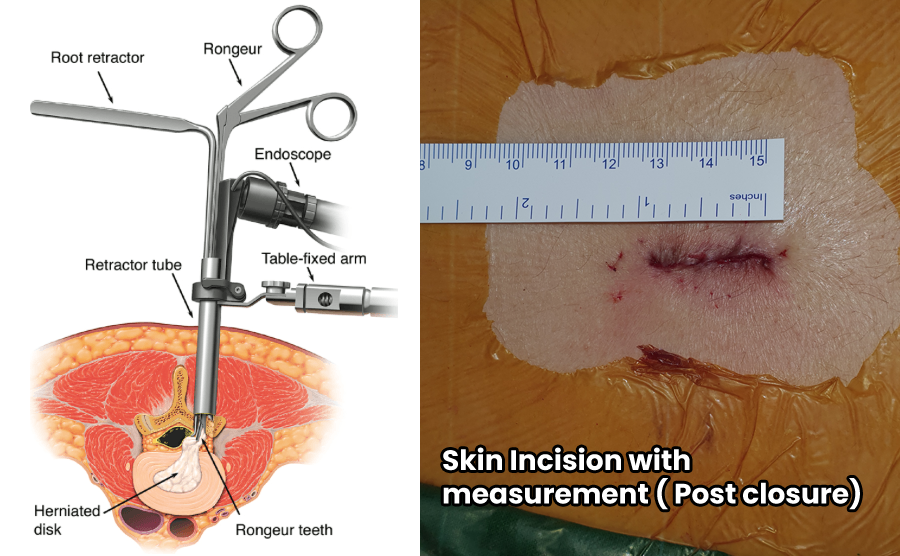
How it works
- A small incision is made in the back over the herniated disc.
- A small tube or endoscope is inserted through the incision to access the disc.
- Specialized, tiny instruments are used through the tube or endoscope to remove the damaged portion of the disc that is pinching a nerve.
- In some cases, a laser may be used to remove part of the disc.
Potential benefits
- Smaller incision: Results in less scarring.
Reduced muscle damage: Minimally invasive techniques spare surrounding muscles. Less pain and blood loss: Patients often experience less post-surgical pain and minimal blood loss. Faster recovery: Patients may have a shorter hospital stay and a quicker return to daily activities. Lower infection risk: There can be a lower risk of surgical site and other infections.
Potential risks
- Risks and complications can include infection, bleeding, blood clots, nerve damage, and an allergic reaction to anesthesia.
A potential complication is an “incidental durotomy,” a tear in the membrane surrounding the spinal nerves. There is a higher risk of disc herniation recurrence compared to open surgery, though more research is needed.
What to expect after surgery
- You will be monitored in a recovery area, and pain will be managed.
Gentle movement, such as sitting or walking, can begin soon after surgery. Most patients can go home the same day, while others may stay for 1-2 days. You will likely need someone to help you for the first 24-48 hours. Activity will be restricted for at least the first six weeks, with a gradual return to full activity within about four to six weeks.
If you have any questions or concerns regarding nerve root blocks or other spinal treatments, feel free to reach out to us at the Bangalore Spine Specialist Clinic. Your health and well-being are our top priorities!
Dr. Shashidhar.B.K has proved to be an expert in Spine Surgery delivering high quality of patient care through evidence based medical practice. He Has a special interest in Endoscopic and Robotic Spine Surgeries. He is an academic spine surgeon and active participant in workshops and Spinal conferences around the World .