Article by Dr.Shashidhar.B.K, Spine surgeon
If you are reading this, you are likely suffering from that debilitating combination of neck pain and electric, shooting, or burning sensations down your arm. You’ve likely tried physical therapy, medications, and perhaps even injections, but the pain, numbness, and weakness persist. Your doctor may have mentioned that it’s time to consider surgery.
First, take a breath. It is completely normal to feel a mix of hope and anxiety. You are standing at a crossroads. For your condition—called Cervical Radiculopathy—two primary surgical options are now widely available:
- ACDF (Anterior Cervical Discectomy and Fusion)
- TDR (Total Disc Replacement, or Artificial Disc Replacement)
My goal, as a dedicated spine surgeon, is not just to perform a procedure but to guide you through this decision. Both operations aim to do the same fundamental thing: remove the problem disc that is pinching your nerve. But they do it differently, and the long-term impact on your body varies. Let’s break down these options in plain English, humanizing the choice that lies ahead of you.
Understanding the Root of the Problem: Cervical Radiculopathy
To appreciate the surgeries, we must understand the issue. Your neck (cervical spine) is a marvel of engineering. It supports the heavy weight of your head, allows you to turn, tilt, and nod, and crucially, it protects the spinal cord.
Between your spinal bones (vertebrae) are soft pads called discs. They act as shock absorbers. Think of them like a jelly doughnut. The tough outer layer (annulus) holds in a soft inner core (nucleus).
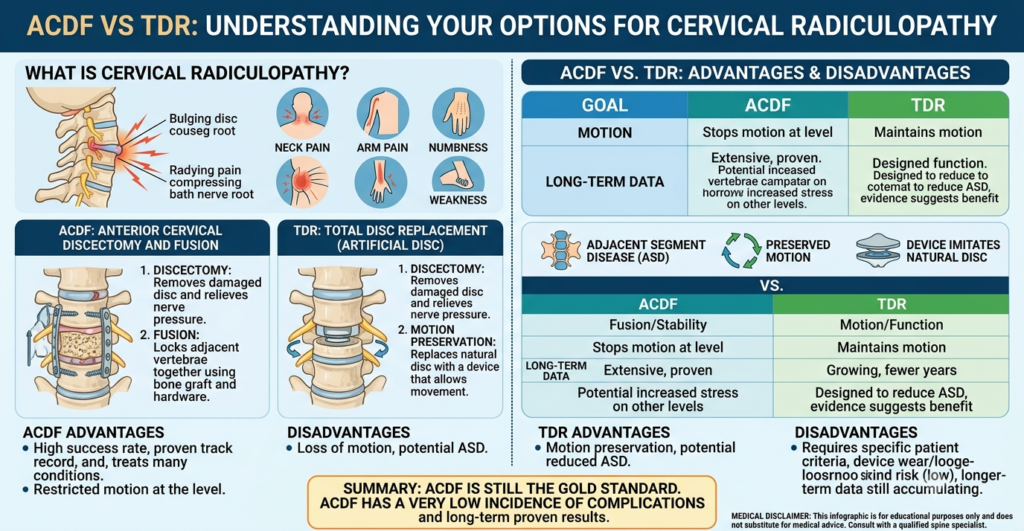
Cervical Radiculopathy occurs when a nerve root in your neck is compressed or irritated as it exits the spinal cord. This compression is usually caused by two things:
- A Herniated Disc: Part of the “jelly” is pushed out, pressing on a nearby nerve.
- Bone Spurs (Osteophytes): As discs wear down with age (part of “spondylosis”), bone grows in abnormal places, narrowing the space for the nerve.
The symptoms are agonizing because your nerves are your body’s communication system. A “pinched nerve” sends constant distress signals—leading to pain, a feeling of “pins and needles,” or weakness in your hand and arm.
When non-surgical treatments fail, it means your nerve needs more space. It needs the pressure removed. Both ACDF and TDR accomplish this, but with different philosphies.
ACDF: The Gold Standard for a Reason
ACDF stands for Anterior Cervical Discectomy and Fusion. It is the single most common operation performed in the cervical spine. If you are exploring options for ACDF in Bangalore
, you are looking at a solution with an incredible history of success.
The ACDF Procedure Explained
- Anterior (Front) Approach: We make a small, horizontal incision in a skin crease on the front of your neck, rather than the back. This approach avoids cutting through the major, powerful neck muscles, which significantly reduces post-operative pain and speeds up recovery.
- Discectomy: We carefully remove the entire damaged disc, including any bone spurs that are pressing on your spinal cord or nerve roots. Once this is done, the nerve is completely decompressed (relieved).
- Fusion: The key differentiator. Since the disc is now gone, the space must be filled to prevent the collapse of your spine. We place a small, rigid spacer (often a cage made of medical-grade plastic or titanium) containing a bone graft where your disc used to be. Your body is a remarkable healer: over the coming months, your vertebrae will treat that spacer as a scaffold, and new bone will grow through and around it, fusing the two bones above and below into one single, solid, stable bone. A small metal plate and tiny screws are often used to hold everything in place while the healing happens.
Patient Perspective on ACDF
Think of ACDF as a permanent stabilizer. It stops all movement at that specific, painful joint. By creating a fusion, it aims to eliminate the source of pain forever. Its success rate is famously high, and we have many patients at our clinic in Bangalore who have reclaimed their lives, sports, and careers after ACDF.
Advantages and Disadvantages of ACDF (Table)
| ADVANTAGES OF ACDF | DISADVANTAGES OF ACDF |
| Excellent, Proven Relief: Superior ability to eliminate arm pain (the main goal). | Loss of Motion: Motion is eliminated at the fused level. While minimal for one level, it can feel “stiffer.” |
| The Gold Standard: Over 60 years of data. We know exactly how it behaves and its extremely low complication rate. | Bone Healing Required: A fusion relies on your body growing bone (arthrodesis). This can fail (called “pseudarthrosis”). |
| Highly Versatile: Can treat severe degeneration, large bone spurs, or instability that TDR cannot. | Adjacent Segment Disease (ASD): By fusing one level, more stress is placed on the discs directly above and below it. This could cause them to wear out faster. |
| Immediate Stability: The plate and cage provide excellent structural stability right away. | Longer Recovery (for Fusion): While you feel better quickly, the full process of the bones “bonding” takes months. |
TDR: The Modern Approach to Preserving Motion
TDR, which stands for Total Disc Replacement, is a newer alternative (about 20 years of robust data) that addresses one specific, legitimate concern about ACDF: the loss of motion. For suitable candidates looking for TDR or ACDF in Bangalore
, the choice can hinge on this desire for flexibility.
The TDR Procedure Explained
The beginning is identical. A TDR procedure follows steps 1 and 2 of ACDF:
- Anterior (Front) Approach (Same as ACDF)
- Discectomy (Same as ACDF: The disc is removed, and the nerve is relieved.)
- The Key Differentiator: Instead of filling that empty space with a rigid bone graft and cage (Fusion), we implant a high-tech, motion-preserving device. This is essentially an artificial joint. It is designed like other joints in your body (think of a ceramic ball moving within a socket, though simpler) to mimic the natural movement of a human disc, allowing bending, tilting, and rotating.
Patient Perspective on TDR
TDR is like installing a new, flexible part. Its core goal is function through motion. The ideal patient wants the pain relief of ACDF but aims to retain the “natural” feel of their neck, potentially avoiding that slight stiffness. They also hope that by preserving movement at this level, they will reduce the risk of wearing out the neighboring joints in the future.
Advantages and Disadvantages of TDR (Table)
| ADVANTAGES OF TDR | DISADVANTAGES OF TDR |
| Motion Preservation: The primary benefit—it maintains natural movement at the operated level. | Less Extensive Data: While proven, TDR has only two decades of data, compared to ACDF’s six. We are still monitoring very long-term results. |
| Equivalent Pain Relief: Study after study shows TDR is as effective as ACDF in curing arm and neck pain. | Strict Selection: TDR is not a solution for everyone. It cannot treat severe osteoarthritis, significant instability, or collapsed disc height. |
| Potential ASD Reduction: Theory (and growing evidence) suggests that by preserving motion, it reduces stress on neighboring discs. | Device Concerns: Like any artificial joint (hip, knee), there is a potential, though very low, risk of the device wearing out, loosening, or migrating. |
| No Bone Graft Needed: Avoids the potential “failed fusion” issue and complications related to bone grafting. | Cost: The sophisticated, often imported disc implants make TDR generally more expensive than ACDF. |
Summarizing: ACDF is Still the Gold Standard
If you are feeling torn, remember this core message: Both operations are exceptionally good at what they were created to do. They both provide relief to patients with cervical radiculopathy.
However, when a spine specialist speaks of the Gold Standard, we mean the standard against which all other treatments are measured. We mean the procedure with the longest, deepest track record of success.
For cervical radiculopathy, ACDF is still the gold standard.
Here is why:
1. Extremely High Success and Low Complication Rates
ACDF is one of the most reliable and safe operations in modern medicine. While all surgery carries risks (which we will discuss during your consultation), the incidence of major complications is consistently very low. I perform ACDF in Bangalore
routinely, and the consistency of the results for pain relief and return to normal life is what makes it so trusted.
2. We Know its Whole Story
ACDF has been studied, refined, and improved upon for six decades. We understand its recovery timeline, its limitations, its long-term impact, and how to maximize its safety. We are not “testing” a new theory.
3. Versatility and Universal Applicability
Nearly any patient suffering from nerve compression in the neck due to a disc herniation or bone spurs can be successfully treated with ACDF. TDR requires a very specific patient “profile” to be successful.
How to Choose: The Bangalore Perspective
Your choice will not be made in isolation. It will be made in my clinic, Bangalore Spine Specialist Clinic
, based on a comprehensive medical assessment. Here is what we prioritize:
- Your MRI and X-Rays: This is non-negotiable. If your imaging shows significant facet joint arthritis or multiple collapsed levels, ACDF will be the safer, more durable choice.
- Your Age and Lifestyle: A younger, active patient with healthy adjacent joints and single-level disease is often a stronger candidate for TDR.
- Your Preference: Some patients value “natural motion” above all else; others find the certainty and long-term track record of fusion more reassuring. There is no wrong answer here; there is only your answer.
At the Bangalore Spine Specialist Clinic, our priority is matching the right surgery to the right patient.
Conclusion: Reclaiming Your Life
If you are suffering from the debilitating symptoms of cervical radiculopathy, the most important takeaway is that relief is available. You do not have to live in pain. Both ACDF and TDR are exceptional operations. ACDF is the time-tested champion, and TDR is the modern contender that is proving its worth.
As a dedicated spine specialist in Bangalore, my job is to ensure you feel empowered and informed. We are not just fixing spines; we are helping you reclaim your ability to hold your child, succeed at your job, and simply turn your head without fear of an electric shock.
If you are in Bangalore or the surrounding areas and are exploring options for ACDF
or disc replacement, I encourage you to schedule a consultation at our clinic. We will walk this path together, from diagnosis to recovery, ensuring that the path you choose is the best one for you.
Related reading
Disclaimer
The content of this blog article, including all text, tables, and images, is for informational and educational purposes only. It does not substitute for medical advice, diagnosis, or treatment. It is not intended to create a patient-provider relationship.
If you are experiencing a medical emergency, call emergency services immediately. All information provided here should be used to facilitate a detailed conversation with a qualified healthcare professional. Do not make medical decisions without consulting a specialist.


